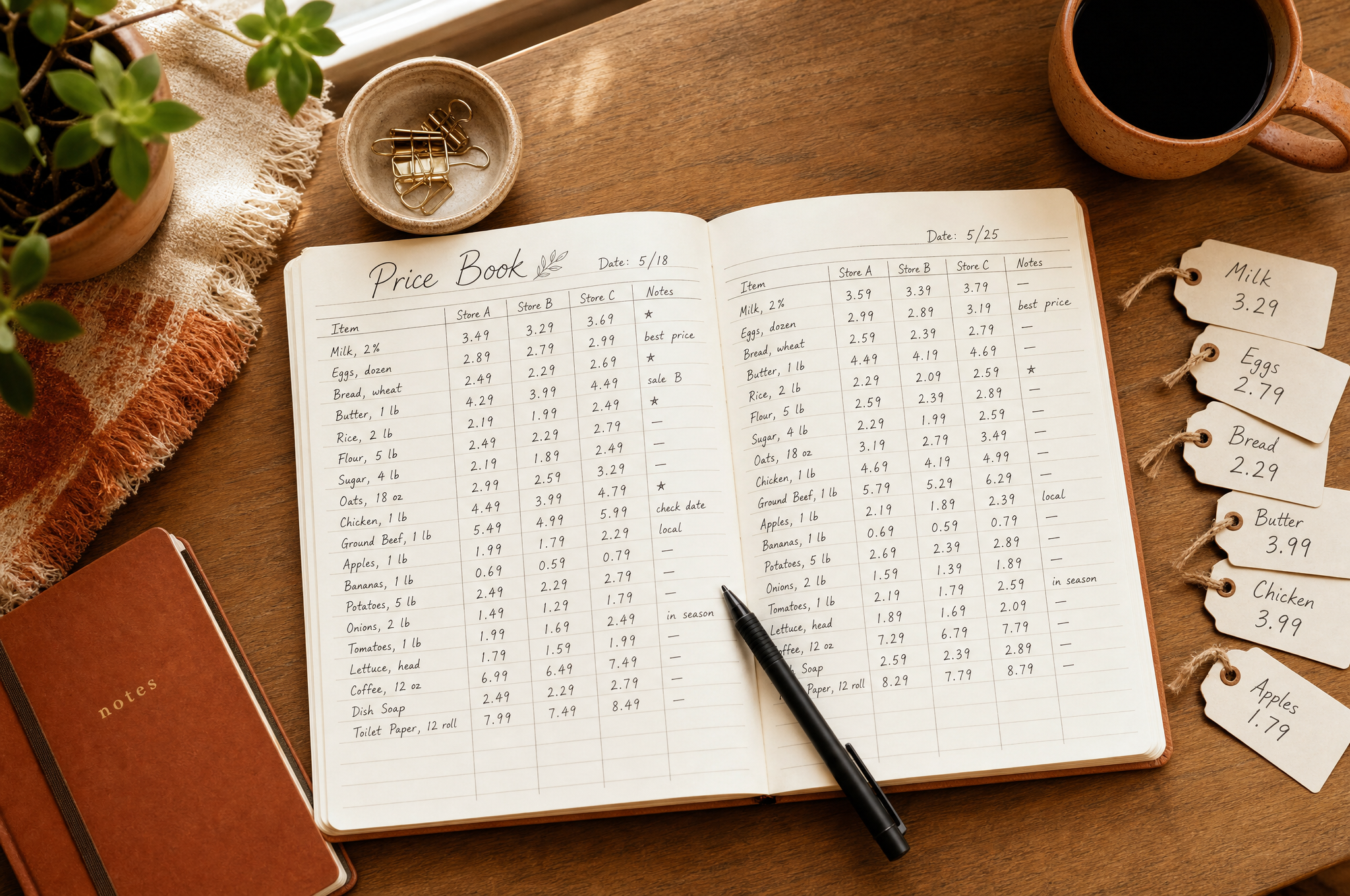
There's a $2 composition notebook on my kitchen counter with a column of numbers in it. That notebook has saved my family more money than every app on my phone combined.
I know that sounds dramatic. We live in an era of price-tracking apps, browser extensions, and AI deal finders. But here's the thing: none of them work as well as a simple notebook where you write down what things actually cost at the stores you actually shop at.
A price book is the most boring, most effective savings tool I've ever used. It takes one afternoon to set up, a few minutes per grocery trip to maintain, and it will permanently change how you shop.
What is a price book?
A price book is a running record of the items you buy regularly, the prices you've paid for them, and where you bought them. That's it. No app, no subscription, no algorithm.
The magic isn't in the notebook itself — it's in the awareness it creates. When you write down that Aldi charges $1.79 for a dozen eggs while Kroger charges $3.29, you stop buying eggs at Kroger. When you track that peanut butter hits $2.49 every seven weeks at your store, you stop buying it at $3.49 "because it's on sale."
The price book does two things: it tells you the cheapest store for each item, and it tells you the rock-bottom sale price so you know when to stock up.
How to build one
Step 1: Choose your format
I prefer a physical notebook because writing things down helps me remember them. But a Google Sheet, the Notes app on your phone, or a dedicated price-tracking template all work. Use whatever you'll actually maintain.
Step 2: List your regular items
Write down the 25-40 items you buy most often. Don't try to track everything — just the things that make up 80% of your grocery spending. For most families, that's:
- Proteins: chicken, ground beef, eggs, milk, cheese
- Pantry: pasta, rice, peanut butter, cereal, bread, flour, sugar
- Produce: bananas, apples, onions, potatoes, lettuce
- Household: toilet paper, paper towels, laundry detergent, dish soap
- Personal care: toothpaste, shampoo, body wash
Step 3: Record current prices
Next time you go grocery shopping, write down the price of each item on your list. Include the size and unit so you can compare accurately — "$2.49 / 18 oz" is useful; "$2.49" alone is not.
If you shop at multiple stores, record prices at each one. The goal is to build a comparison grid:
| Item | Aldi | Kroger | Target | Rock-Bottom |
|---|---|---|---|---|
| Milk (gal) | $2.85 | $3.29 | $3.49 | $2.85 |
| Eggs (doz) | $1.79 | $2.99 | $2.49 | $1.79 |
| Pasta (16oz) | $0.89 | $1.29 | $1.49 | $0.89 |
| Peanut butter (18oz) | $1.95 | $3.49 | $3.29 | $1.95 |
| Chicken breast (lb) | $3.49 | $4.99 | $5.49 | $2.99* |
*Sale price at Kroger, tracked over 6 weeks.
Step 4: Track sale prices over 6 weeks
This is where the price book becomes powerful. For six weeks, whenever you see a sale price for any item on your list — whether in the weekly ad, the store app, or on the shelf — write it down. After six weeks, you'll see patterns emerge. This is the same method I describe in the sale cycle tracking article, but now you're also comparing across stores.
Step 5: Identify your "stock-up" prices
Circle the lowest price you've seen for each item. That's your stock-up price — the price at which you buy extra. Everything else is "buy only what you need."
Once you know your stock-up prices, shopping becomes almost automatic. You see peanut butter for $1.95? Buy two. You see it for $3.49? Walk past. No mental math required.
Using the price book while shopping
Here's how I use mine in practice. Before each shopping trip, I check the store's weekly ad (online or in the app). For each sale item that's on my price book list, I compare the sale price to my rock-bottom price:
- Sale price = rock-bottom price: Stock up. Buy a cycle's worth.
- Sale price within 15% of rock-bottom: Buy what you need for the week.
- Sale price more than 15% above rock-bottom: Skip it. Wait for the real sale.
This takes about three minutes per week. Over a year, those three minutes save me an average of $1,200-$1,800 on groceries.
Common mistakes to avoid
- Tracking too many items. If you try to track 200 items, you'll abandon the price book within a month. Start with 25 items and add more only if it's effortless.
- Forgetting to note the size. "$2.49" means nothing without knowing whether that's for 16 ounces or 24 ounces. Always record the size and compute the unit price.
- Not comparing stores. The biggest savings come from knowing that your regular store is overcharging you on specific items. If you only track one store, you miss this entirely.
- Not updating it. Prices change. Stores change their regular prices annually. Review your price book every six months and update any prices that have shifted.
- Making it too complicated. No color coding, no formulas, no ten-tab spreadsheet. The simpler it is, the more likely you'll use it.
The Unit Price Shortcut
Most shelf tags show the unit price (price per ounce, per pound, etc.) in small print. Use it. When comparing sizes or brands, the unit price tells you the true cost regardless of packaging. Learn more in my unit pricing guide.
What about price-tracking apps?
There are apps that claim to track prices for you. Some are decent — I use Ibotta and Fetch for rebates. But for price tracking specifically, apps have limitations:
- They track national average prices, not your local store's prices
- They often miss store-brand items, which are where the real savings are
- They require accounts, logins, and battery life
- They stop being maintained or change their business model
A notebook has none of these problems. It works offline, it's free, and it captures exactly the data you need for the stores you actually use.
The first weekend
Here's your homework, if you're ready: this weekend, grab a notebook and your last three grocery receipts. Write down the prices of the 25 items you buy most. That's your starting point. Over the next six weeks, add sale prices as you see them.
By the end of week six, you'll have a personalized savings map. And unlike an app, you'll actually understand the data — because you wrote it yourself, one price at a time.
If you want to go deeper, pair the price book with the 6-week sale cycle tracking method. The two work together: the price book tells you what to buy where, and the cycle tracking tells you when to buy it.