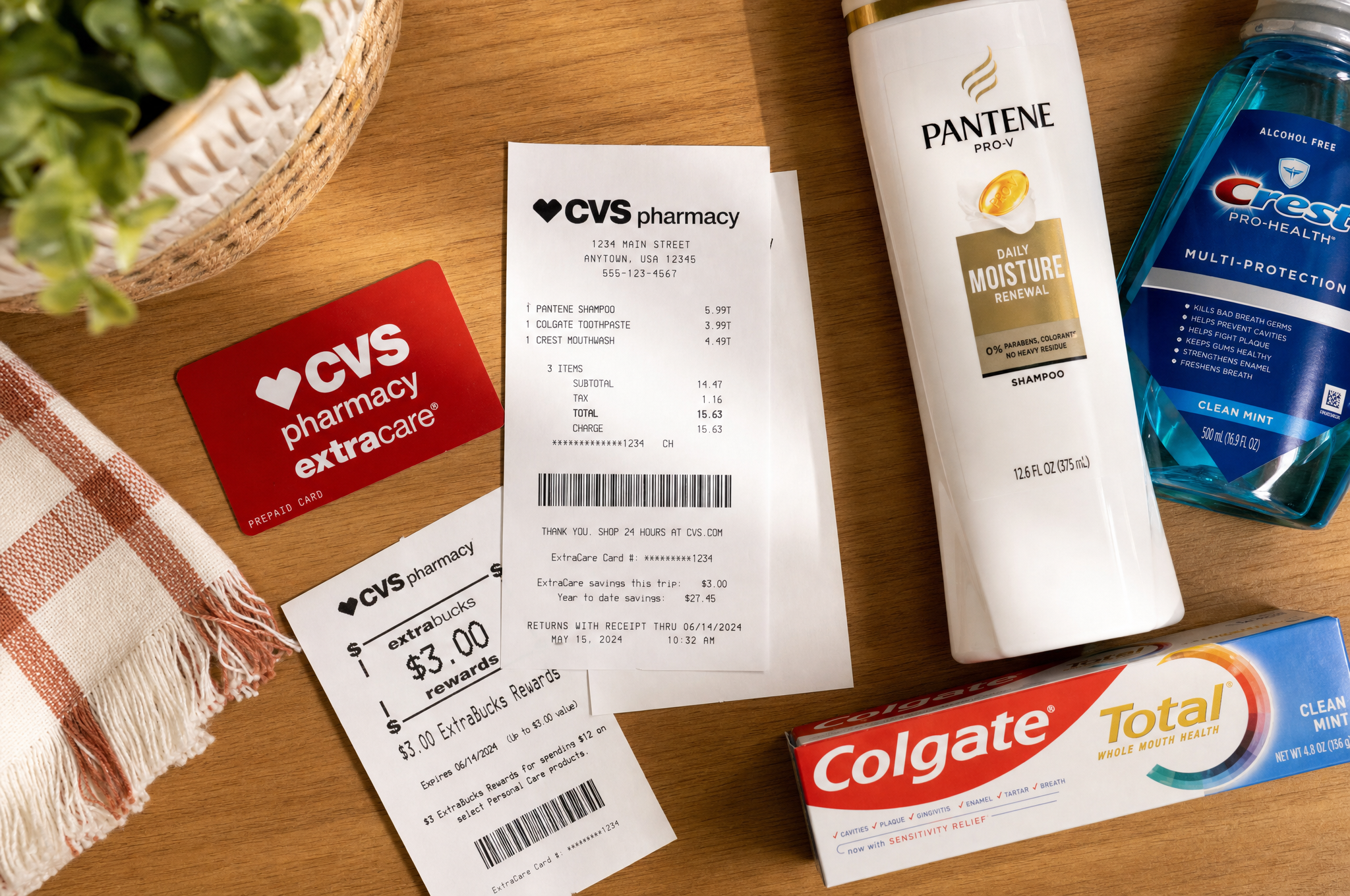
Last month, I walked into CVS with three coupons, an app full of digital offers, and a plan. I walked out with $34 worth of shampoo, toothpaste, and body wash for $2.11. The cashier high-fived me.
That sounds like a brag, and maybe it is a little. But the point is: drugstores are the most underutilized savings opportunity in retail. Most people buy personal care products at the grocery store at full price, completely unaware that CVS, Walgreens, and Rite Aid run rewards programs that can make those same products nearly free.
The catch is that each program works differently, and if you don't understand the mechanics, you'll waste time and earn nothing. Here's the complete breakdown.
CVS: ExtraCare and ExtraBucks
CVS operates on the ExtraCare loyalty program, and its currency is ExtraBucks — store credit that prints on your receipt (or loads to your app) after qualifying purchases. Think of ExtraBucks as CVS dollars that you spend on your next visit.
How ExtraBucks work
- CVS runs weekly promotions like "Buy 2 Get $5 ExtraBucks" on specific products
- You buy the items at full price, and the ExtraBucks print on your receipt
- You use those ExtraBucks on your next purchase, effectively reducing the cost of the first transaction
- ExtraBucks expire about 30 days after issuance — set a reminder
The rolling strategy
The key to CVS savings is "rolling" ExtraBucks. Here's how it works:
- Transaction 1: Buy items that generate ExtraBucks. Pay with cash/card. Receive ExtraBucks on receipt.
- Transaction 2: Buy different items that generate ExtraBucks. Pay with the ExtraBucks from Transaction 1. Receive new ExtraBucks.
- Transaction 3: Repeat. You're constantly converting ExtraBucks into new ExtraBucks, spending very little out of pocket.
Once you have a buffer of ExtraBucks rolling, your out-of-pocket spending drops to almost nothing. I maintain a rolling balance of $10-15 in ExtraBucks and rarely spend more than $5 per CVS trip.
Stacking at CVS
CVS allows the most generous coupon stacking of any drugstore:
- Manufacturer coupon + CVS store coupon + ExtraBucks offer = triple stack
- CVS store coupons come from the weekly ad, the CVS app, and the ExtraCare coupon center (the machine that prints coupons when you scan your card in-store)
- You can also use $ off total coupons (like "$5 off $25") on top of item-specific coupons
Always scan your ExtraCare card at the coupon center when you walk in. It prints store coupons based on your purchase history, and these often match items you buy regularly.
Walgreens: Balance Rewards and Register Rewards
Walgreens has two separate reward systems, which confuses people. Let me clarify:
myWalgreens Rewards (points)
You earn points on every purchase (1,000 points = $1). Points can be redeemed for dollars off your purchase. Earn rates vary: 1% on general purchases, higher rates on featured items. Points don't expire as long as you shop at least once every six months.
This is the simpler system but the earn rate is slow. I earn about $2-3 per month in points with regular shopping.
Register Rewards (RR)
Register Rewards are Walgreens' version of ExtraBucks — they print on your receipt after purchasing promotional items. Same concept: buy a featured item, get $X in Register Rewards for your next trip.
The critical difference from CVS: you cannot use Register Rewards from one product to buy the same product again. If you earn $4 RR from buying shampoo, and you try to buy the same shampoo with those RRs, they won't print again. You have to "roll" between different products.
Walgreens also has a strict coupon-to-item ratio: you need as many items as you have coupons (including Register Rewards). If you have 3 manufacturer coupons and want to pay with 2 Register Rewards, you need 5 items total. This is why Walgreens shoppers buy cheap "filler" items — pencils, candy, etc. — to make the coupon math work.
Stacking at Walgreens
- Manufacturer coupon + Walgreens store coupon (from the weekly ad or app) + Register Rewards offer
- You can pay with Register Rewards from a previous transaction, but not from the same product
- Walgreens does not allow overage — coupons are adjusted down to the item price
Rite Aid: Wellness+ and BonusCash
Rite Aid (now part of Walgreens Boots Alliance, but still operating stores) runs the Wellness+ program with BonusCash as its currency. The mechanics are similar to CVS:
- BonusCash prints on your receipt after buying promotional items
- BonusCash can be used on almost anything in the store
- Wellness+ tiers (Bronze, Silver, Gold) earn points faster for frequent shoppers
- Manufacturer coupons stack with BonusCash offers
Rite Aid has fewer locations than CVS or Walgreens, but if you have one nearby, the savings potential is comparable. The BonusCash system is actually simpler than Walgreens' two-currency setup.
Which drugstore is best?
For most people, the answer is: whichever one is closest to you. All three offer similar savings potential. But if you have access to multiple stores, here's how I rank them:
| Feature | CVS | Walgreens | Rite Aid |
|---|---|---|---|
| Easiest to learn | ★★★★★ | ★★★ | ★★★★ |
| Coupon stacking | ★★★★★ | ★★★★ | ★★★★ |
| Rolling rewards | ★★★★★ | ★★★ | ★★★★ |
| App experience | ★★★★ | ★★★★ | ★★★ |
| Overall savings | ★★★★★ | ★★★★ | ★★★★ |
CVS wins on simplicity and coupon flexibility. If you're going to pick one drugstore to master, make it CVS.
My Weekly Drugstore Routine (15 minutes)
Sunday: Check CVS app for weekly deals (5 min). Monday: One CVS trip, buying items that generate ExtraBucks, using manufacturer coupons and previous ExtraBucks (10 min). That's it. Average weekly savings: $15-25 on personal care items I'd buy anyway.
What to buy at drugstores (and what to skip)
Buy here:
- Personal care: Toothpaste, shampoo, body wash, deodorant — these are the moneymakers. With rewards, I rarely pay more than $1 for any of these.
- Over-the-counter medicine: Pain relievers, allergy meds, cold medicine. Drugstores frequently run "buy $15, get $5 in rewards" promotions.
- Cosmetics: Drugstore makeup brands (Maybelline, L'Oreal, Revlon) go on sale regularly and accept manufacturer coupons.
- Seasonal clearance: After every holiday, drugstores clear out seasonal merchandise at 50-75% off. First-week-after-holiday markdowns are the deepest.
Skip here:
- Groceries: Drugstore food prices are inflated. Buy food at the grocery store.
- Household cleaners: Unless there's a specific rewards promotion, grocery store and warehouse club prices are lower.
- Greeting cards and gift wrap: Dollar stores and craft stores are cheaper.
Getting started
If you've never used drugstore rewards, start with CVS. Download the app, create an ExtraCare account, and next Sunday, check the weekly ad for items that generate ExtraBucks. Buy one or two of those items using a manufacturer coupon if you have one. Use the ExtraBucks on your next trip.
It takes about three weeks to build a comfortable rolling balance. After that, you'll wonder why you ever bought toothpaste at the grocery store.
For more on stacking coupons at drugstores, check out my coupon stacking guide. And if you're tracking personal care prices in your price book, you'll quickly see which items are cheapest at the drugstore versus the grocery store.